
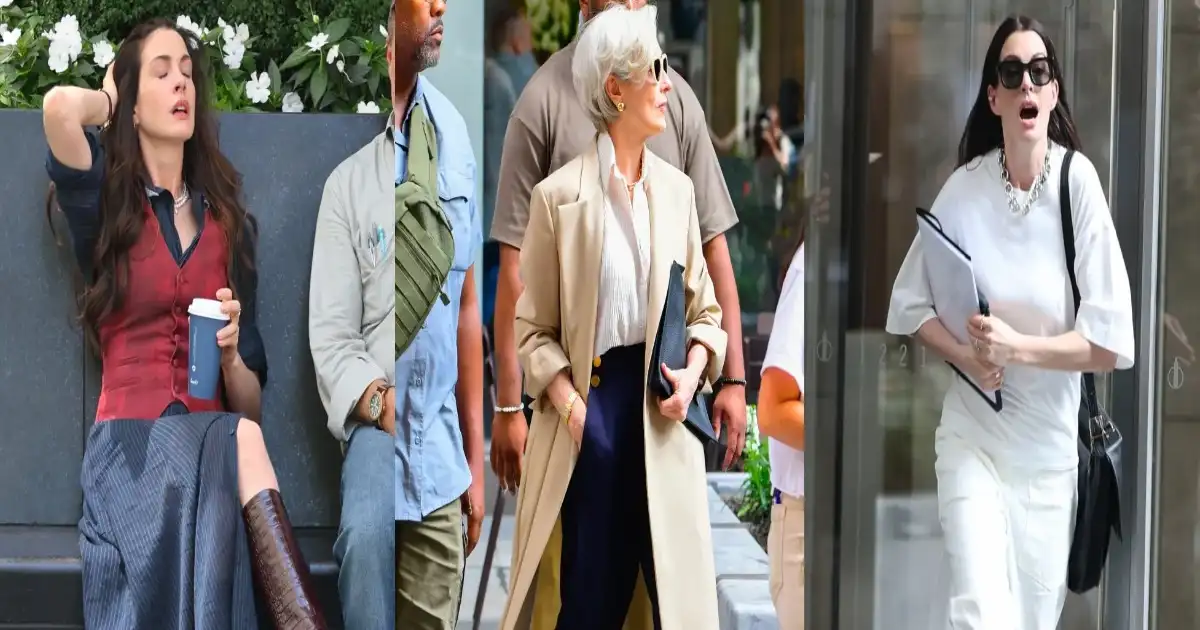
The Devil Wears Prada 2 Detailed Break-even Analysis: How Disney Turned a Sequel into a $250 Million Profit Machine
HOLLYWOOD — The cerulean sweater is back, and this time, it is carrying a massive $100 million price tag. The Devil Wears Prada 2 lands in theaters today, May 1, 2026, marking exactly two decades since Miranda Priestly first redefined the fashion hierarchy. While the nostalgic buzz is at a fever pitch, the financial stakes are even higher than a pair of vintage Chanel boots.
Disney and 20th Century Studios have officially kicked off the summer movie season by greenlighting a sequel that cost roughly $100 million to produce—a significant leap from the $35 million budget of the 2006 original.
With opening weekend projections hovering between $80 million and $95 million, the industry is bracing for a rare legacy sequel that might actually justify its existence on the balance sheet before the first Monday morning box office reports even hit.
The strategic impact of this deal extends far beyond a simple cash grab for Disney. By securing the original quartet—Meryl Streep, Anne Hathaway, Emily Blunt, and Stanley Tucci—Disney has locked in an IP acquisition victory that bridges the gap between Gen X nostalgia and Gen Z aesthetic culture.
In the ongoing Streaming Wars, this theatrical-first strategy is a calculated move to maximize theatrical window profits before the film eventually anchors the Disney+ and Hulu libraries around August or September 2026.
The broader market context here is the “Dopamine Gap.” Audiences expect the high-fashion spectacle of the first film, but the reality must beat those expectations to maintain the ROI. If the reality of the sequel—the script, the fashion, the stakes—surpasses the $80 million expectation, the backend points for the A-list cast will start looking very lucrative.
The current market mood suggests that legacy sequels are the only “sure things” left in a volatile theatrical landscape, yet there is a lingering skepticism about the rising costs of talent.
Is Meryl Streep worth four times her 2006 rate in a market where stars often struggle to open a non-superhero film?
While the original film was a surprise hit that turned a modest budget into $326.7 million, this sequel enters a world where the production budget alone is $100 million, meaning the margin for error has evaporated.
We are looking at a film that needs to function as a global event, not just a cozy comedy-drama, to hit its profit thresholds.
The $100 Million Runway: Budgetary Blueprints and Salary Jumps
To understand the break-even math, we have to look at the massive shift in talent costs over the last twenty years. Variety reported that the production budget for The Devil Wears Prada 2 hit the $100 million mark pre-marketing.
A staggering $30 million to $50 million of that total likely went straight to the cast. Meryl Streep, who was reportedly paid roughly $5 million for the original role after an initial offer of $2.5 million, is now estimated to be commanding between $10 million and $15 million, with some sources even whispering about a $20 million mark for her return as Miranda Priestly.
This salary jump reflects the “Change” essence of a good story: the character’s journey from a supporting player to a cinematic icon.
In 2006, Fox 2000 Pictures cut corners, using a stand-in for Streep in Paris scenes and slashing $10 million worth of scripted moments to keep the budget under $41 million.
In 2026, Disney is taking the opposite approach. As Streep famously noted in recent press materials, “this one, honey, they spent the money!” The production involves high-end locations and a “stacked cast” that includes newcomers like Kenneth Branagh and Simone Ashley, which further inflates the daily burn rate.
The P&A Paradox: Brand Collabs vs. Traditional Spends
If the production cost is $100 million, the P&A (Prints and Advertising) budget is almost certainly matching it.
Boxoffice Pro and others tracking the film note that the marketing blitz for The Devil Wears Prada 2 is uniquely woven into Disney’s entire media ecosystem, including livestreams across Disney+, ABC, and TikTok.
This is “Content Atomization” at its finest: one red carpet premiere turned into 50 pieces of social media content distributed across every possible platform.
However, Disney has a secret weapon to offset these costs: massive brand partnerships. Launchmetrics highlights a shift from traditional ad spends to organic brand visibility, with labels like Gabriela Hearst, Chanel, and Jean Paul Gaultier securing millions in Media Impact Value (MIV) through production visibility.
Partnerships with Google, Samsung, Starbucks, and Vogue have essentially turned the film into a high-end commercial vehicle, allowing the studio to subsidize its traditional P&A spend while Nigel—played by Stanley Tucci—demonstrates Google’s AI “Try On” tool in the film’s promotional cycle.
The Profit Threshold: Cracking the $250 Million Glass Ceiling
For a $100 million film, the standard Hollywood math dictates a break-even threshold of roughly 2.5 times the production budget to account for the theatrical rentals and marketing.
This places the profit line for The Devil Wears Prada 2 at approximately $250 million. With a predicted domestic opening range of $80 million to $95 million, the film could theoretically recover nearly 40% of its total break-even goal in its first three days.
The theatrical rentals typically see the studio take home about 50% of the domestic box office and 40% of the international take. If the sequel mirrors the first film’s “leggy” run—which lasted nearly five months in 2006—the profit could be astronomical.
Unlike a CGI-heavy Marvel blockbuster that often requires a $500 million floor just to stop the bleeding, this contemporary fiction piece is positioned for a high ROI relative to its cost.
BingeTake Verdict
This is a masterclass in modern IP acquisition and franchise maintenance.
Disney has essentially bought back the “cool factor” of a twenty-year-old brand and scaled it for a 2026 audience that craves high-production value and legacy stars.
While a $100 million budget for a drama-comedy seems steep, the pre-release tracking and massive brand collaboration MIV suggest this is one of the safest bets Disney has made all year.
I expect this film to cross the $250 million break-even mark within its first 14 days of release, quickly moving into pure profit before it even hits the SVOD window in late summer. This is an easy win for the studio and a massive payday for the cast.
Ganesh Mishra, Business Analyst
Join BingeTake
Get Box Office Updates directly on WhatsApp from your personal Box Office Insider.
Related Posts





You May Have Missed

About the Author

Ganesh Mishra
Business Analyst
Hi, I'm Ganesh. I’ve spent the better part of my career obsessed with how the entertainment industry actually works behind the scenes, looking at the contracts, the streaming wars, and the massive deals that decide what you’ll be watching next Friday. I love breaking down complex business moves into simple stories, and I’m here to make sure you’re always the most informed person in the room when it comes to the business of entertainment.