
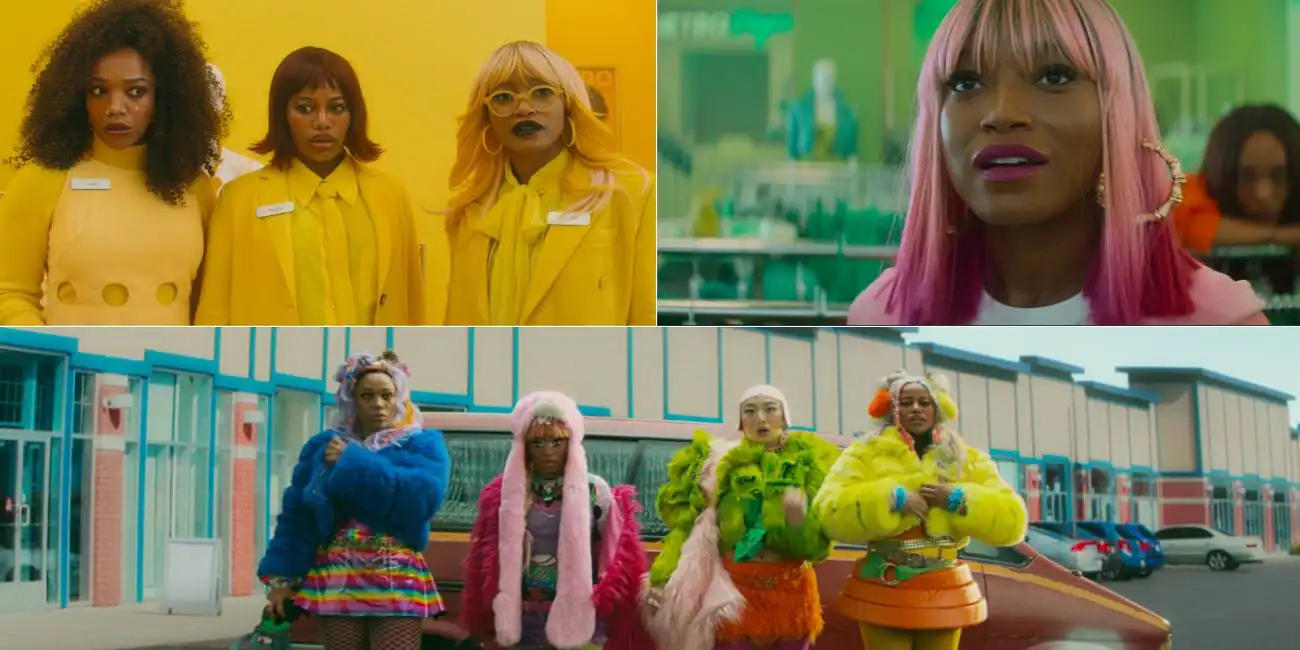
NEW YORK — The boutique theatrical market faces a massive financial stress test this week. Distributor Neon is pushing its most expensive project in company history into theaters on May 22.
Filmmaker Boots Riley’s I Love Boosters lands with immense critical capital, boasting a stellar 93% on Rotten Tomatoes out of its South by Southwest festival premiere. But in the unforgiving math of modern theatrical windowing, high-concept class warfare is an expensive gamble.
Neon has underwritten a radical anti-capitalist heist comedy, and the industry ledger demands an entirely new level of ticket-window performance for an indie darling.
Testing the Limits of Indie Budgets in the Streaming Era
This release is a critical indicator for the health of non-studio theatrical cinema.
For years, prestige indie banners survived by playing a conservative game: produce for single digits, hunt for a breakout, and maximize SVOD streaming buyouts downstream.
Neon is shattering that playbook by investing a hard $20 million into production budgets for a single, highly stylized film.
If Riley’s signature absurdism can scale to match this price tag, it creates a viable blueprint for premium independent cinema. If it underperforms, it will trigger an immediate chill across the specialty market, forcing distributors back into safe, micro-budget corners.
The town is currently looking at early domestic tracking figures indicating a modest $5 million to $7 million North American opening weekend.
Traditional suits might look at those single-digit projections and panic, wondering how an auteur-driven film can justify its record-breaking cost. They are asking the wrong questions.
Neon isn’t trying to build a traditional studio blockbuster. They are executing an aggressive E-E-A-T strategy designed to exploit the gap between generic streaming content and premium theatrical experiences.
The numbers are now on record. What they actually signal is a highly calculated gamble on long-term execution over immediate explosive profit.
The $50 Million Break-Even Ledger
Let us unpack the raw data behind the curtain.
Industry tracking reports and production updates confirm that Neon poured $20 million directly into principal photography and physical production.
That makes I Love Boosters a massive financial anomaly for a studio that typically operates in a much leaner zone. When you factor in the inevitable domestic marketing push, the cost of manufacturing premium physical assets, and the standard theatrical exhibition revenue splits, the true financial finish line becomes clear.
I Love Boosters needs to secure roughly $50 million globally across its theatrical lifetime to comfortably clear its break-even floor and achieve pure ROI.
Compare this baseline to the historical performance of similar high-concept genre pieces.
A look at the performance of Demi Moore’s last major theatrical venture, The Substance, reveals a baseline domestic pull of $17.6 million against an $18 million production budget.
The Substance eventually clawed its way to a $77.3 million worldwide total, leaning heavily on a 5.5x domestic opening-to-earnings multiplier to pull itself into deep profitability.
Riley’s team managed to keep the physical footprint remarkably efficient despite the film’s wild narrative swings.
Production documents indicate that they utilized volume stages and innovative practical tricks rather than drowning the project in bloated post-production visual effects overages. By keeping the VFX pipeline scaled down to a fraction of studio tentpoles, Neon effectively protected its downside.
The film features a star-studded ensemble, including Keke Palmer, Demi Moore, and LaKeith Stanfield. Yet, the real financial leverage comes from its lean, localized filming approach rather than runaway overseas set construction.
Shoplifting as a Radical Act of ROI
The underlying business logic extends far beyond the domestic box office. Neon’s strategy relies heavily on a dual-engine monetization structure. Because Focus Features and Universal Pictures are stepping in to steer the international distribution pipeline, Neon has insulated itself from the terrifying volatility of foreign theatrical markets.
The high budget isn’t just an expense; it acts as a premium placement fee to secure top-tier awards-season visibility and highly lucrative SVOD windowing rights.
In an industry drowning in generic content, a visually stunning, critically bulletproof property commands a premium from platforms desperate to prevent subscriber churn.
The BingeTake Verdict
This is an incredibly gutsy, structurally sound play by Neon.
Pushing a $20 million budget into a non-franchise, uncompromised piece of satire is exactly how independent distributors remain relevant in 2026. By capping production costs and sharing international liabilities with Universal and Focus Features, Neon has engineered a brilliant hedge.
Even if domestic theater returns stall at a conservative $30 million, the cascading value of premium ancillary distribution, streaming licenses, and global syndication rights will ensure this ledger settles firmly in the black.
Ganesh Mishra, Business Analyst
What do you think of Neon’s record-breaking $20 million bet on Boots Riley? Can a radical critique of consumer culture successfully convince general American moviegoers to open their wallets during a crowded summer frame?
Join BingeTake
Get Box Office Updates directly on WhatsApp from your personal Box Office Insider.
Related Posts





You May Have Missed

About the Author

Ganesh Mishra
Business Analyst
Hi, I'm Ganesh. I’ve spent the better part of my career obsessed with how the entertainment industry actually works behind the scenes, looking at the contracts, the streaming wars, and the massive deals that decide what you’ll be watching next Friday. I love breaking down complex business moves into simple stories, and I’m here to make sure you’re always the most informed person in the room when it comes to the business of entertainment.